
What is trichoscopy and what can it reveal?
Have you noticed that your hair is thinning?
Is your hair falling out more than usual? Have you noticed any changes to your scalp, or has your hair become thinner and weaker?
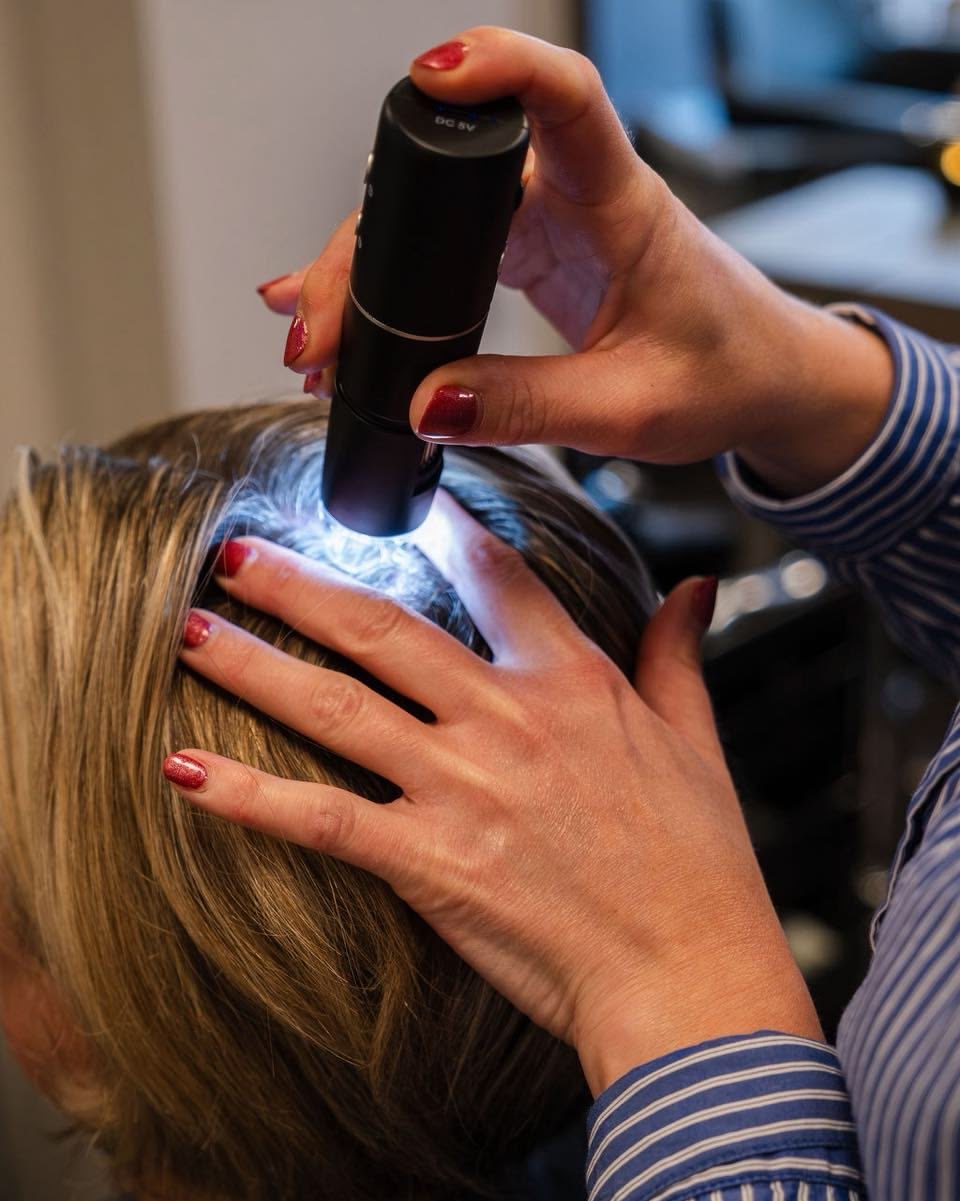
In such cases, a visual examination alone is often not sufficient. Trichoscopy allows the scalp and hair to be examined under high magnification, revealing changes that are not visible to the naked eye
What is trichoscopy?
Trichoscopy is a non-invasive method for a detailed examination of the scalp and hair using a specialised device – a trichoscope. With the aid of magnification, it is possible to observe the structure of the hair shaft, the follicular openings, the condition of the scalp and various changes associated with hair loss and thinning. The examination does not require any hair or skin samples to be taken and is usually quick and comfortable for the client.
What can a trichoscopic analysis reveal?
1. The condition of the scalp When magnified, various characteristics of the scalp may be observed – for example, redness, flaking, build-up and other visible changes. This can provide valuable information in cases of complaints such as itching, dandruff, sensitivity or excessive oiliness.
2. Changes in hair structure
Trichoscopy allows the hair to be examined in detail – its thickness, structure and any differences between individual hairs. This is particularly useful where thinning is suspected or where the hair appears visibly sparser.
3. Signs of thinning Sometimes a person notices that ‘they have less hair’, but cannot pinpoint the reason. A trichoscopic analysis can reveal characteristics that point to a process of hair miniaturisation and specific patterns of thinning.
4. Different types of hair loss
There is no single cause of hair loss. Trichoscopy can help in the assessment of various patterns of hair loss, including where there is suspicion of:
* androgenetic hair thinning;
* diffuse hair loss;
* alopecia areata;
* hair loss caused by mechanical stress;
* other changes that require further assessment.
It is important to note that trichoscopy is a diagnostic tool, and the results must be interpreted in the context of the patient’s symptoms, medical history and, where necessary, other tests and consultation with a doctor.
Why is trichoscopy important in cases of hair loss?
One of the most common mistakes is to assume that all hair loss is the same. Two people may have a similar complaint – for example, ‘my hair is falling out’ – but the cause and the approach to the problem may be different. That is why it is important to assess the condition first, rather than starting at random with shampoos, ampoules or dietary supplements. The clearer we understand what is happening to the scalp and hair, the more informed the next step can be.
When is it appropriate to carry out a trichoscopic analysis?
It is a good idea to see a specialist if you notice:
* excessive or prolonged hair loss;
* visible thinning of the hair;
* widening the road;
* thinning in a specific area;
* a change in the structure of the hair;
* redness, flaking or itching of the scalp;
* sudden appearance of bald patches;
* hair loss that does not respond to standard treatment.
Trichoscopy can also be useful when you want to track the condition of your hair over time and to compare the changes following the measures taken.
How is a trichoscopic analysis carried out?
The process usually begins with a discussion about your symptoms, when they started and how they have changed. This is followed by an examination of the scalp and hair using a trichoscope. Various areas of the scalp are examined to provide a more comprehensive assessment, and the findings are considered in the context of the individual case. Following the analysis, you may be given guidance on the next steps and whether further tests or a consultation with a medical specialist are required.
How should you prepare for a trichoscopy?
To ensure that the assessment of the scalp is not complicated, it is advisable, prior to the examination:
* Do not apply oils or hair masks to the scalp;
* do not use dry shampoo;
* avoid using styling products on your scalp;
* Do not carry out aggressive peeling or exfoliation immediately before the test.
Do not stop any treatment or medication prescribed to you on your own simply because you have a trichoscopy coming up.
Trichoscopy is not simply ‘taking a look at the hair’.
When you notice hair loss, that is the visible result. But there may be a different process at work behind it. Trichoscopy allows us to take a closer look at what is happening to the scalp and hair. If you notice hair loss, thinning or a change in the condition of your scalp, don’t just rely on guesswork.
There is a reason for hair loss.
Let’s find it.
Book an appointment for a trichoscopic analysis at Panova SMP.